(And Why We Love It)
There’s no gentle way to say this.
Indian weddings are not subtle.
They are:
- Loud
- Layered
- Slightly overwhelming
- Deeply, unapologetically extra
And yet—no one really wants them any other way.
Because beneath all the choreography, décor, and dramatic entries, there’s something else going on.
Indian weddings are not just events.
They’re performances of belonging.
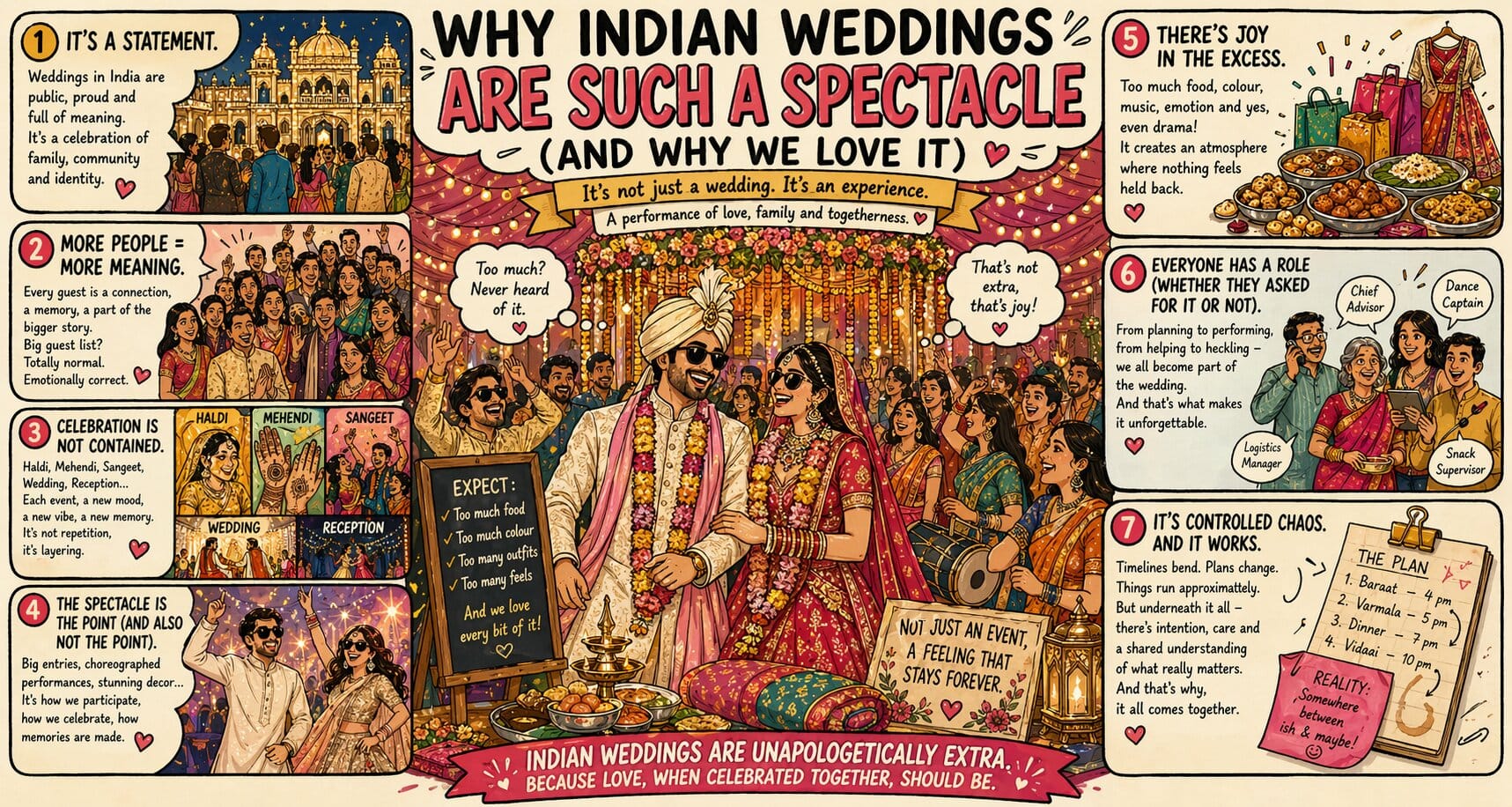
1. It’s Not Just a Wedding. It’s a Statement.
In many cultures, weddings are private.
In India, weddings are… public.
Not in a performative way (okay, sometimes in a performative way), but in a “this matters, and we want everyone to know it” way.
It’s a statement about:
- Family
- Community
- Identity
And yes, sometimes… about scale.
2. More People = More Meaning
In India, inviting more people doesn’t dilute the experience.
It enhances it.
Every extra guest represents:
- A connection
- A memory
- A thread in a much larger story
Which is why guest lists expand in ways that feel mathematically impossible but emotionally correct.
3. Celebration Is Not Contained
In many places, weddings are one day. Maybe two.
In India, they unfold.
Haldi, mehendi, sangeet, wedding, reception—each event has its own mood, its own personality, its own aesthetic.
It’s not repetition. It’s layering.
And with every layer, the celebration becomes less about a moment and more about an experience.
4. The Spectacle Is the Point (And Also Not the Point)
Yes, there are:
- Big entries
- Coordinated outfits
- Dramatic lighting
- Dance performances that may or may not have been rehearsed properly
But here’s the thing.
The spectacle isn’t just for show.
It’s how people participate.
It’s how:
- Cousins bond
- Friends get involved
- Families come together
The spectacle is the format.
The emotion is the content.
5. There’s Joy in the Excess
Minimalism is having a moment globally.
Indian weddings did not get that memo.
And honestly? That’s okay.
There’s a kind of joy in abundance:
- Too much food
- Too much colour
- Too many outfits
It creates an atmosphere where nothing feels held back.
Where celebration is allowed to be… full.
6. Everyone Has a Role (Whether They Asked for It or Not)
Indian weddings are participatory.
You don’t just attend.
You:
- Help
- Suggest
- Coordinate
- Occasionally stress
From choreographing dances to managing guests to giving opinions no one asked for—everyone becomes part of the wedding.
And strangely, that’s what makes it feel alive.
7. It’s Controlled Chaos. And It Works.
From the outside, it can look chaotic.
Timelines shift. Plans evolve. Things run… approximately.
And yet, it works.
Because underneath it all, there’s:
- Intention
- Care
- A shared understanding of what matters
The structure may bend. The experience doesn’t.
Final Thought
Indian weddings are not trying to be quiet, minimal, or restrained.
They are trying to be:
Joyful
Inclusive
Memorable
And sometimes, the best way to do that is to go all in.
Not because you have to.
But because when it works, it creates something rare:
A celebration that feels bigger than the event itself.